Showing posts with label paradigm shift. Show all posts

Saturday, March 30, 2024

On WR 140, "Bizarre Rings" [Actually "Shells"], and the Nested Double Layers Discovered in the SAFIRE Project's Test Chamber.

Wolf-Rayet 140 (WR 140) [Image Credit: NASA, ESA, CSA, STScI, NASA-JPL, Caltech] 
vs. nested "plasma double layer" shells produced in the SAFIRE Project (phase III) test chamber [Image: video screenshot].


It never ceases to amaze me, the absolutely remarkable things that end up going unremarked. Well, it's about high time to remark upon one...

I've meant to post this blog or something like it for a long time, but had hoped one of my online colleagues would have stepped up to the plate with a more technical analysis, from our point of view, by now...

Thus far, it hasn't yet happened. So, you'll have to bear with my non-technical 'looks like' analysis. 

(Yes, I'm fully aware, 'looks like' doesn't necessarily mean 'is.' But ... I think this comparison nonetheless bears further rigorous investigation. Since, if 'looks like' turns out to be 'is,' it can tell us something extremely interesting about the cosmos, IMO. Possibly even something paradigm-shifting...)

So, not-so-long-ago now, the James Webb Space Telescope [JWST] team put out one or more press release(s) and published a paper or two in the journal Nature, which were picked up by the likes of news outlets such as Space, et al, regarding a novel observation of the Wolf-Rayet star "WR 140" (AKA, "Wolf-Rayet 140"). 

They noted that JWST had observed a heretofore unknown feature / structure unique to the the space around WR140. Specifically, they had captured an image of faint, somewhat ghostly, "bizarre rings" around the putative binary star system.

But, more than just 'rings,' Ryan Lau (Assistant Astronomer at the National Science Foundation’s NOIRLab, and principal investigator of the Webb Early Release Science program that observed WR 140) is quoted as saying:

"I was amazed. Although they resemble rings in the image, the true 3D geometry of those semi-circular features is better described as a shell."

Not just one shell mind you, but at least 17, if not more. The feature is structures a bit like an onion, with layers inside layers inside layers (at least 17 [and counting?]).

The question, my dear readers, is how we *interpret* the novel observation.

The team has forwarded a hypothesis regarding binary stars, solar winds colliding every 8 years or so and pushing out shells of dust in a somewhat spiral / conchoid manner, that then manages to somehow turn into this extremely regularly structure of nested spheres.

I, on the other hand, immediately likened the structure to something *entirely different* and altogether familiar to me: a specific novel result reported in several presentations about experiments done at the SAFIRE Project lab (testing the Electric Star / Electric Sun hypothesis, forwarded by retired professor of electrical engineering Donald Scott).

Not only was it a novel result, but it was actually initially observed & reported *prior* to the JWST observations, at least as early as 2015. Though the initial unrefined observations [below] occurred in Phase I of the SAFIRE Project, which may have {?} completed earlier than the 2015 conference presentation relating to Phase II of the SAFIRE Project:
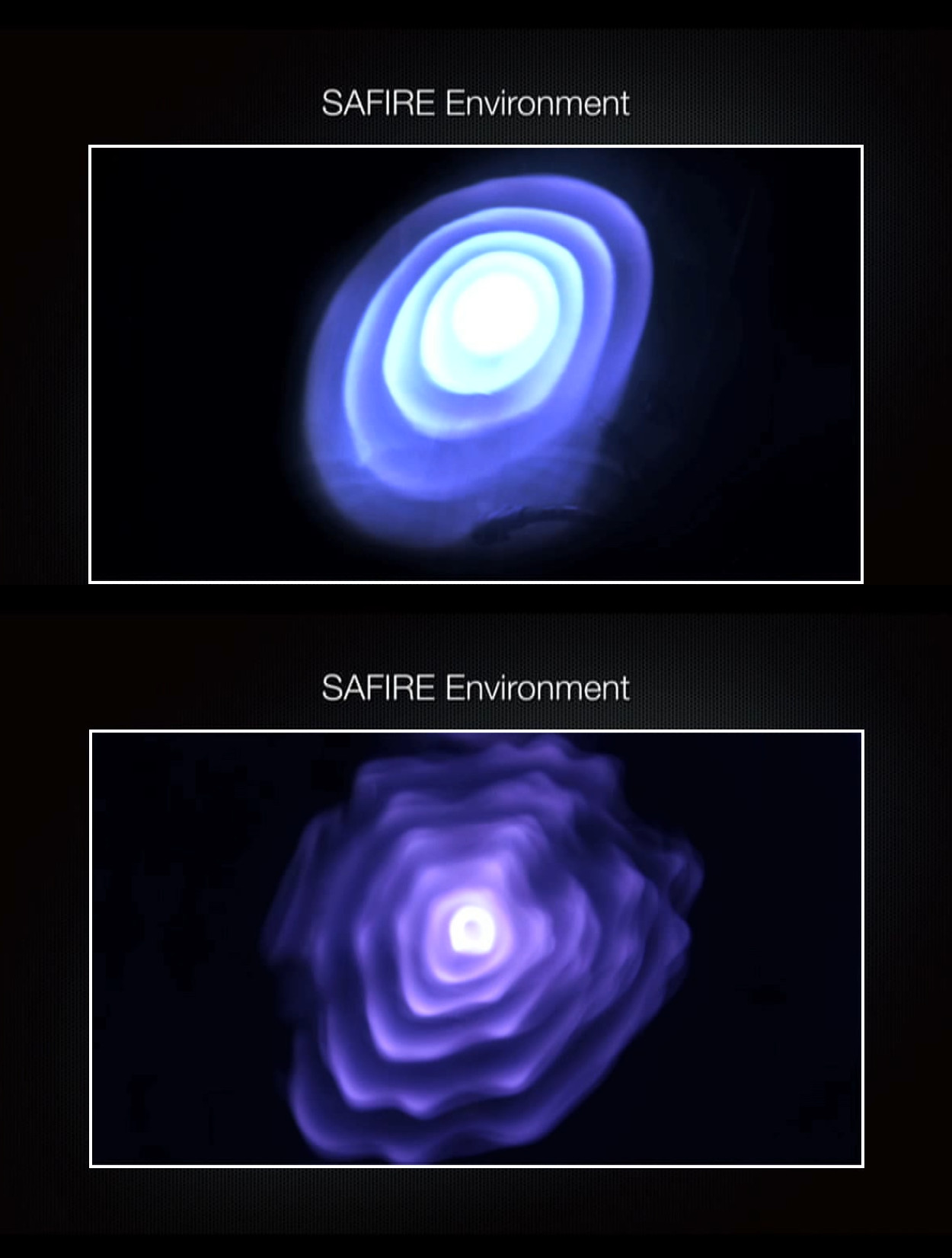
Early images from the SAFIRE Project (Phase I). [Image: Composite of video screenshots.]

More refined observations and control of the plasma double layers came slightly later, as in this still frame from a presentation in 2017 (video of the evolving double layer shells in the experiment is slightly later, at this timestamp):

Later, more refined & controlled nested spherical "double layer" shells
inside the SAFIRE Project test chamber. [Image: video screenshot]

The JWST observation, however, was not reported until late 2022 (fully 7+ years after the SAFIRE Project had initially observed presented its experimental observations in 2015 [or earlier]).

So, for me, unlike for the JWST team, there was little if any "shock" or "surprise" at their observation of such a multi-shelled structure around one or more stars. 

In fact, to my mind, to the contrary, it should be an *expected* observation around stars, *under specific electrical/plasma conditions*, commensurate with the prior experimental observation in the SAFIRE Project test chamber, *if the Electric Sun/Star hypothesis is true and/or the experimental results obtained in the SAFIRE Project test chamber are applicable/scalable to stellar and/or cosmological scales.* [And we already know that plasma behaviors, and structures are scalable, spatially and temporally, over many O.O.M. (orders of magnitude).]

And, just as in the JWST observation (from Ryan Lau, previously quoted):

"I was amazed. Although they resemble rings in the image, the true 3D geometry of those semi-circular features is better described as a shell."

SAFIRE Project lead Monty Childs described the evolution of the Double Layer shells thusly, in his earlier 2016 presentation:

"...And these, uh, these 'double layers' ... We ended up finding that we had two, three, four, ... twenty. {!} These aren't, uh, disks, these are spherical, um, discharges. Plasma has a unique characteristic where it's translucent as you look through the center of it, and it looks like it's a disk. But, in fact, it's not. What you're looking at, actually, are spheres."

Not only are the 'double layers' spherical in the SAFIRE Project test chamber, but you can get more than one shell... 2, 3, 4, ... 20! Again, just as in the JWST observation of [at least] 17 currently observable concentric shells around WR 140... 

Electrical effects in plasma can *directly* and *reproducibly* generate *precisely* the multi-shelled structure observed by JWST [7+ years after the SAFIRE Project results].

In my opinion, this should probably be headline news. 

There should at least be a reasonable, reasoned discussion of the SAFIRE results / observations and their potential applicability to stellar atmospheres [precisely the domain it was designed to investigate], and to the cosmos at large. Presumably the SAFIRE Project team could give some insight into what they observed in the test chamber, under what specific discharge regimes, and thus what specific characteristics to look for in astrophysical observations of WR 140 in order to further investigate, differentiate between the models, and decide which theory/explanation most accurately fits/explains empirical observation.

Further, should the result/correlation be upheld, it nigh demands a careful reconsideration of some basic tenets of modern stellar theory and likely cosmology at-large, since this experiment stems not from the 'Standard Model,' but instead from the 'Electric Universe' / 'Electric Star' Model(s), wherein the prime mover and shaker of the cosmos is not the exceedingly weak force of gravitation, but the 39 OOM stronger [that's 10^39 or a 1 with 39 zeroes after it {!} times stronger] electromagnetic force...

In that model, the 'galactic web' is not 'neutral' or 'dead' but a network of interconnected 'power lines' [of a sort] lighting up, well, basically EVERYthing (stars, galaxies, etc.). Far more can be said on that, but I'll confined my remarks to the subject at hand for now, as a microcosm of the macrocosmic issue(s) at hand.

Given recent apparent falsifications of the Big Bang (fully formed galaxies with too high a redshift, thus allegedly "too mature, too early after the [alleged] Big Bang") and other tenets of the 'Standard Model,' it's about time to shake things up, and shift our thinking to a new paradigm. 

In my considered opinion, that is some flavor of Electric Universe, Plasma Cosmology, Magnetohydrodynamic Universe, Electrodynamic Universe, or however you bloody well want to phrase it. 

It's all the same song and dance. And it's time to do the Electric Slide/Boogie, 'cause ... according to They Might be Giants: "The Sun is a Miasma of Incandescent Plasma..." [Well, you're almost there, anyway! Just a few steps more...] Sing us out, boys!


Friday, April 27, 2012

Dark Days For "Dark Matter"

A central pillar of the Standard Model has taken a shellacking this month. Two separate studies have come out contra "dark matter." If this central pillar falls, the entire house of cards may collapse under its own weight.

So, what is "dark matter?"

"Dark matter" or "missing mass" is an abstract concept that came out of the failure of gravitational cosmology to account for certain observations of objects in space.

"The idea of dark matter was born at Caltech in 1933 ... In observations of a nearby cluster of galaxies named the Coma cluster, Fritz Zwicky calculated that the collective mass of the galaxies was not nearly enough to hold them together in their orbits.

"He postulated that some other form of matter was present but undetected to account for this 'missing mass.' Later, in the 1970's and '80's, Vera Rubin similarly found that the arms of spiral galaxies should fly off their cores as they are orbiting much too quickly."
http://www.spacedaily.com/reports/How_We_See_Dark_Matter_999.html

Essentially dark matter is an error bar on the Standard Model of [Gravitational] Cosmology. We can calculate how much mass is needed, gravitationally speaking, to hold galaxies and such together. We can then observe galaxies and other objects in space across the range of the electromagnetic spectrum from radio up through gamma rays and assay whether or not the actually observable mass of the objects matches up with theoretical predictions.

Simply put: the observable matter in galaxies is insufficient to account for their characteristics.

There are, thus, two options:
  1. Consider the gravitational models falsified and move on to a different theory.
  2. Forgo falsification and invent a new theory or substance to salvage the gravitational model.
 Option two leads down a path paved with "dark matter." Basically, invisible, unobservable material is hypothesized then sprinkled liberally wherever the math says there's not enough mass, but there should be. In effect it is an error bar on the gravitational model, telling us precisely how much mass is 'missing' (under the assumption that gravitational theories are correct, despite observations having falsified them).

Don't worry, it gets weirder...

Not only is the stuff invisible, in order not to throw off other theories, it also only interacts gravitationally with other matter.
"Dark matter neither emits nor absorbs light or other electromagnetic radiation, and so cannot be seen directly with telescopes."
http://en.wikipedia.org/wiki/Dark_matter

That is, it doesn't emit electromagnetic radiation (the aforementioned EM spectrum, from radio up through gamma rays) and neither is it influenced by electric or magnetic fields. But, one supposes this shouldn't be surprising since it is, at its heart, only a mathematical kludge.

But wait, it gets weirder!

Despite dark matter not interacting with the known electromagnetic forces, some theorists want to shoehorn in some kind of electromagnetic-like force anyway, but one specific to dark matter.
"...just like ordinary matter couples to a long-range force known as 'electromagnetism' mediated by particles called photons,' dark matter [may couple] to a new long-range force known (henceforth) as 'dark electromagnetism,' mediated by particles known (from now on) as 'dark photons.'"
http://blogs.discovermagazine.com/cosmicvariance/2008/10/29/dark-photons/
It's difficult to tell whether these folks are just pulling our legs or they're actually serious. Though, the fact they've submitted a paper on the subject seems to imply the latter.

So, okay, say for a moment that we accept the premise that dark matter exists. We don't. But let's say we did. This should be a testable theory.

And, testing it, some scientists are (in various ingeniously clever and indirect ways, keeping in mind we can't directly observe dark matter since it doesn't emit EM radiation or interact with electric or magnetic fields and we still have no idea how gravity itself actually works at the most basic physical level).

But, before dark matter has even been experimentally confirmed, scientists have already started incorporating it into other theories and applying this new tool to other fields of inquiry, building up a rickety structure of beliefs and assumptions all resting on this now load-bearing pillar. Reification is a dangerous thing. Once you start believing a thing is real, you stop questioning its reality and it becomes an unquestioned (even if also unproven) assumption, often mistaken for a "fact."

Recently, some scientists tried calculating how often WIMPs (Weakly-Interacting Massive Particles; one "dark matter" candidate particle) impact the human body. They predicted about "once a year," but in working through the problem they came up with something closer to "once a minute."

But, as such things go, their results have tons of assumptions, not least of which being that dark matter is abundant everywhere, including here. A reasonable assumption, considering that upwards of 23% of the mass/energy of the universe.

But, wait a minute... What's that? Breaking news! Two studies released in the past month have offered tentative refutations of dark matter based on actual observations of local space (in the Sun's and the Milky Way's neighborhoods). And one experiment here on Earth appears to be offering null results (that is, no evidence of "dark matter").

Earlier this week, scientists released the results of a survey of the Milky Way's local cosmic neighborhood. The press release had the following to say:
"'Once we had completed our analysis, a new picture of our cosmic neighbourhood emerged,' says Pawlowski.

"Team member Pavel Kroupa, professor for astronomy at the University of Bonn, adds 'We were baffled by how well the distributions of the different types of objects agreed with each other.' As the different companions move around the Milky Way, they lose material, stars and sometimes gas, which forms long streams along their paths. The new results show that this lost material is aligned with the plane of galaxies and clusters too. 'This illustrates that the objects are not only situated within this plane right now, but that they move within it,' says Pawlowski. 'The structure is stable.'

"''In the standard theories, the satellite galaxies would have formed as individual objects before being captured by the Milky Way,' explains Kroupa. 'As they would have come from many directions, it is next to impossible for them to end up distributed in such a thin plane structure.'"
http://www.ras.org.uk/news-and-press/219-news-2012/2118-do-the-milky-ways-companions-spell-trouble-for-dark-matter
If the observations stand up to scrutiny, the Standard Model has a hard time explaining them with the current dark matter-centric theories. Team members put the situation thus:
"Our model appears to rule out the presence of dark matter in the universe, threatening a central pillar of current cosmological theory. We see this as the beginning of a paradigm shift, one that will ultimately lead us to a new understanding of the universe we inhabit."
http://www.ras.org.uk/news-and-press/219-news-2012/2118-do-the-milky-ways-companions-spell-trouble-for-dark-matter

The question is, will the paradigm actually shift or will additional 'fixes' and 'patches' be added, order to save the oft-falsified theory?

A week or two ago, a different paper was released showing that observations of local objects in the Sun's neighborhood (stars, dust, gas) account well for their motions via gravity, with no room for any extra "dark matter."

The press release puts the implications bluntly:
“The amount of mass that we derive matches very well with what we see -- stars, dust and gas -- in the region around the Sun,” says team leader Christian Moni Bidin ... “But this leaves no room for the extra material -- dark matter -- that we were expecting. Our calculations show that it should have shown up very clearly in our measurements. But it was just not there!”

"Despite the new results, the Milky Way certainly rotates much faster than the visible matter alone can account for. So, if dark matter is not present where we expected it, a new solution for the missing mass problem must be found. Our results contradict the currently accepted models. The mystery of dark matter has just become even more mysterious."
http://www.eso.org/public/news/eso1217/
That is, no mass is "missing" from our local neighborhood. Ergo, no dark matter is required to explain the motions of objects in local space, despite the Standard Model's expectations that it should be there. As they say, galaxies "certainly rotate faster than the visible matter alone can account for," gravitationally speaking. Their results "contradict the currently accepted models" and "a new solution ... must be found."

In fact, this revelation has implications for detection efforts here on Earth. Even if dark matter exists, if there is none in our local neighborhood, it'll be a lot harder to detect.
"The new results also mean that attempts to detect dark matter on Earth by trying to spot the rare interactions between dark matter particles and “normal” matter are unlikely to be successful."
http://www.eso.org/public/news/eso1217/

But more likely it won't be detected because, well, it's 'just not there.' It's a figment of the over-active imagination of astrophysical mathemagicians.

But, that brings us to the 'testability' requirement of theories and the experiment currently being run here on Earth to try to detect dark matter: Xenon 100.

It got some press back in the day (2012) when it released preliminary results from its first 11 days of operation.
"Now, a third experiment called Xenon 100, which its makers say is even more sensitive than the other two [DAMA & CDMS-II], has failed to detect the impact of any dark matter particles, casting doubt on the earlier results. 'Dark matter particles continue to escape our instruments,' says Xenon 100 spokesperson Elena Aprile of Columbia University in New York."
http://www.newscientist.com/article/dn18839
However, there was a modicum of backlash against the Xenon 100 results, but the team has continued on undeterred, preferring their results to speak for themselves.

Appropriately enough, the team published a new paper in 2011 regarding the results of 100 days of Xenon 100 data. Their conclusion:
"In 100.9 live days of data, acquired between January and June 2010, no evidence for dark matter is found."
http://arxiv.org/abs/1104.2549
 So, at 100 days, the results are the same as they were at 11 days. "No evidence for dark matter is found."

In all, it seems that dark matter is on the shakiest of footings and current research is not bearing it out. The question, again, is whether the repeatedly falsified model will finally be thrown out... Time will tell.

It is suggested that researchers follow-up, embrace and extend the fully electrodynamic Particle-in-Cell (PIC) simulations carried out by Los Alamos plasma physicist Anthony Peratt back in the early 1980's, showing that galaxies can and should be explained in terms of the ubiquitous electrically conductive plasma permeating the universe. Starting from an electrodynamic point of view, galaxy rotation curves come directly out of the simulations, no dark matter required.

Astrophysicists need to move on from one of the weakest forces (gravity) to one of the strongest forces (electromagnetism), and acknowledge the electrodynamic nature of the universe as a whole.

We already know that we live in a so-called "magnetic universe." But, then again, we also know from whence springeth magnetic fields. Magnetic fields are generated by electric currents. Period.
"...steady electric and magnetic fields cannot generate themselves. Instead, they have to be generated by stationary charges and steady currents. So, if we come across a steady electric field we know that if we trace the field-lines back we shall eventually find a charge. Likewise, a steady magnetic field implies that there is a steady current flowing somewhere. All of these results follow from vector field theory (i.e., from the general properties of fields in three-dimensional space), prior to any investigation of electromagnetism."
http://farside.ph.utexas.edu/teaching/em/lectures/node37.html

"...all steady magnetic fields in the Universe are generated by circulating electric currents of some description."
http://farside.ph.utexas.edu/teaching/em/lectures/node35.html
If we live in a magnetic universe, more fundamentally, we live in an electric universe. Live it, love it, deal with it.

So, lets dispense with the pixies and fairy dust and get down to the business of determining what actually runs the universe. Answers are at hand, if we're courageous enough to slaughter a few sacred cows in the process.

Monday, February 13, 2012

Joined at the Hip: Magnetic Fields and Electricity

Hello world. I'm here and this is my obligatory first post! I must here recount my primary exegesis on the relationship between electricity and magnetism. Hopefully you will read and enjoy it before moving on to reading any of my other posts. 

I will, throughout this post, refer to the words of others who have summarized the currently accepted views on classical electrodynamics. Thus, I do not consider the majority of this post to be 'original research,' merely a collated regurgitation of well-stated facts.

Hopefully, by the end of this post, you will believe this simple thesis, as I do: electric currents are the sole source of magnetic fields in the universe.

It seems an outrageously simple statement. Can it be true? Put simply, yes.

For the first and simplest statement of fact, we'll turn to the Hyperphysics site:
"Magnetic fields are produced by electric currents, which can be macroscopic currents in wires, or microscopic currents associated with electrons in atomic orbits."
http://hyperphysics.phy-astr.gsu.edu/hbase/magnetic/magfie.html
This is an extraordinarily simple and factual statement. Magnetic fields are produced by electric currents. These can be macroscopic currents in wires or these can be atomic-scale currents where the net collective motion of the electrons around the nuclei of atoms constitutes the 'electric current' (this is relevant primarily for the explanation of 'permanent' magnetism, as in bar magnets or horseshoe magnets).

But, is it correct? Do electric currents produce magnetic fields? Even at the atomic scale?

Let us first consider the general case and then come back to atomic scales and 'permanent' magnets.

Wikipedia seems to be in basic agreement with this non-controversial assessment:
"Electric current [I, above] produces a magnetic field [B, above]. The magnetic field can be visualized as a pattern of circular field lines surrounding the wire."
http://en.wikipedia.org/wiki/Electric_current#Electromagnetism
Expanding on this concept incrementally, one can also relate electric currents and magnetic fields to electric fields:
"An electromagnetic field (also EMF or EM field) is a physical field produced by moving electrically charged objects. ... The field can be viewed as the combination of an electric field and a magnetic field. The electric field is produced by stationary charges, and the magnetic field by moving charges (currents); these two are often described as the sources of the field."
http://en.wikipedia.org/wiki/Electromagnetic_field
The World Health Organization offers a similar explanation:
"Electric fields are created by differences in voltage: the higher the voltage, the stronger will be the resultant field. Magnetic fields are created when electric current flows: the greater the current, the stronger the magnetic field. An electric field will exist even when there is no current flowing. If current does flow, the strength of the magnetic field will vary with power consumption but the electric field strength will be constant."

"Magnetic fields are created only when the electric current flows."
http://www.who.int/peh-emf/about/WhatisEMF/en/
So, what can we take away from all this? I'll let Richard Fitzpatrick of the University of Texas at Austin summarize it thus (from a course on classical electromagnetism):
"...steady electric and magnetic fields cannot generate themselves. Instead, they have to be generated by stationary charges and steady currents. So, if we come across a steady electric field we know that if we trace the field-lines back we shall eventually find a charge. Likewise, a steady magnetic field implies that there is a steady current flowing somewhere. All of these results follow from vector field theory (i.e., from the general properties of fields in three-dimensional space), prior to any investigation of electromagnetism."
http://farside.ph.utexas.edu/teaching/em/lectures/node37.html
Electric fields originate at one or more charged particles. Electric currents (the net motion of like-charged particles in the same direction or of oppositely charged particles in opposite directions) generate magnetic fields.

A little bit of history from NASA physicists Dr. David P. Stern and Dr. Mauricio Peredo may put these statements into perspective:
"People not familiar with magnetism often view it as a somewhat mysterious property of specially treated iron or steel."

"Out in space there is no magnetic iron, yet magnetism is widespread. For instance, sunspots consist of glowing hot gas, yet they are all intensely magnetic."

"It is all related to electricity."

"Close to 1800 it was found that when the ends of a chemical "battery" were connected by a metal wire, a steady stream of electric charges flowed in that wire and heated it. That flow became known as an electric current. In a simplified view, what happens is that electrons hop from atom to atom in the metal."

"In 1821 Hans Christian Oersted in Denmark found, unexpectedly, that such an electric current caused a compass needle to move. An electric current produced a magnetic force!"

"Andre-Marie Ampère in France soon unraveled the meaning. The fundamental nature of magnetism was not associated with magnetic poles or iron magnets, but with electric currents. The magnetic force was basically a force between electric currents."

"--Two parallel currents in the same direction attract each other.
--Two parallel currents in opposite directions repel each other.
"

"Here is how this can lead to the notion of magnetic poles. Bend the wires into circles with constant separation:"


"--Two circular currents in the same direction attract each other.
--Two circular currents in opposite directions repel each other.
"
http://www-istp.gsfc.nasa.gov/Education/wmfield.html
So, at its simplest, the 'magnetic field' is actually a force felt between electric currents. Electric currents are the source of the magnetic field. The stronger an electric current the stronger its associated magnetic field (or, put another way, the stronger the force felt by another electric current some finite distance away).

But, "what of 'permanent magnets'?" you ask. No measurable current flows along the length of a bar magnet. Certainly this explanation must be false if a magnetic field can be generated without a current flow!

Well, not exactly. It is true that there are no currents flowing from one end of the bar magnet to the other. However, each atom can be considered to constitute its own electric current which generates an associated magnetic field:
"...[according to] the Ampère model, ... all magnetization is due to the effect of microscopic, or atomic, circular bound currents, also called Ampèrian currents, throughout the material. For a uniformly magnetized cylindrical bar magnet, the net effect of the microscopic bound currents is to make the magnet behave as if there is a macroscopic sheet of electric current flowing around the surface, with local flow direction normal to the cylinder axis."
http://en.wikipedia.org/wiki/Ampere_model#Amp.C3.A8re_model
In short, the adjacent portion of currents flowing in the same direction cancel. So, the entire volume inside a magnet effectively cancels mathematically in terms of currents. However, for the outside layer of atoms in the magnet, there are no adjacent currents external to the magnet to cancel them and the magnet as a whole acts as if there is a sheet of current flowing there.

We can return to Richard Fitzpatrick's course on Classical Electrodynamics for an illustration of this idea:
"...atoms consist of negatively charged electrons in orbit around positively charged nuclei. A moving electric charge constitutes an electric current, so there must be a current associated with every electron in an atom. In most atoms, these currents cancel one another out, so that the atom carries zero net current. However, in the atoms of ferromagnetic materials (i.e., iron, cobalt, and nickel) this cancellation is not complete, so these atoms do carry a net current. Usually, the atomic currents are all jumbled up (i.e., they are not aligned in any particular plane) so that they average to zero on a macroscopic scale. However, if a ferromagnetic material is placed in a strong magnetic field then the currents circulating in each atom become aligned such that they flow predominately in the plane perpendicular to the field. In this situation, the currents can combine together to form a macroscopic magnetic field which reinforces the alignment field. In some ferromagnetic materials, the atomic currents remain aligned after the alignment field is switched off, so the macroscopic field generated by these currents also remains. We call such materials permanent magnets."
http://farside.ph.utexas.edu/teaching/302l/lectures/node77.html
So, it seems that so-called 'permanent magnets' are merely a special case wherein tiny electric currents at the atomic level add up to an apparent macroscopic magnetic field. So long as the majority of those individual magnetic domains remain aligned, as they do in ferromagnets (metallic permanent magnets), the macroscopic field will persist.

I believe it is not safe to come to our concluding remarks on the subject of the relationship between electricity and magnetism.

Drs. Stern and Peredo conclude their historical piece on magnetic fields succinctly thus:
"In space, on the Sun and in the Earth's core, electric currents are the only source of magnetism." (Emphasis added.)
http://www-istp.gsfc.nasa.gov/Education/wmfield.html
Professor Richard Fitzpatrick similarly concludes his lecture on why magnetic monopoles do not exist:
"In conclusion, all steady magnetic fields in the Universe are generated by circulating electric currents of some description."
http://farside.ph.utexas.edu/teaching/em/lectures/node35.html
Fitzpatrick further concludes his lecture on the origin of permanent magnetism thus:
"In conclusion, all magnetic fields encountered in nature are generated by circulating currents. There is no fundamental difference between the fields generated by permanent magnets and those generated by currents flowing around conventional electric circuits. In the former, case the currents which generate the fields circulate on the atomic scale, whereas, in the latter case, the currents circulate on a macroscopic scale (i.e., the scale of the circuit)."
http://farside.ph.utexas.edu/teaching/302l/lectures/node77.html
Hopefully, at this juncture we have all arrived together at the same non-controversial conclusion. That is to say, the outrageously simple thesis proffered at the outset is in fact correct:
Electric currents are the sole source of magnetic fields in the universe.
This extremely simple understanding forms the basis of this blog. It is here suggested that this basic premise can be used to reverse engineer a new emergent understanding of our universe.

"How so?" you might ask...

Wikipedia, while an imperfect resource, occasionally offers a few salient nuggets, such as this one:
"Electric current can be directly measured with a galvanometer, but this method involves breaking the electrical circuit, which is sometimes inconvenient. Current can also be measured without breaking the circuit by detecting the magnetic field associated with the current."
http://en.wikipedia.org/wiki/Electric_current#Electromagnetism
Why is this important? Well, consider the above statement. If we understand that electric currents generate magnetic fields, that also allows us an avenue of inquiry. If we see a magnetic field but the electric current is inconvenient or impossible to get to, we may examine the characteristics of the magnetic field and work backward to determine characteristics of the electric current that must by definition also be present to drive the observed magnetic field.

So, why is that important with respect to understanding the universe? 

My, my! Quite a lot of questions you've got there... Okay, I'll tell you why this is important. 

Being perfectly frank, everywhere we look in space, it is permeated by large-scale magnetic fields. They have been implicated in everything from star birth to shaping molecular clouds. The earth has a magnetosphere and the solar magnetic field flips every 11 years for reasons heretofore not well understood. Even so-called extremely 'young' galaxies can be permeated by strong magnetic fields.

In point of fact, there is so much 'magnetism' out there that it has led prominent institutions to declare that we live in a 'Magnetic Universe!' However, the source of magnetic fields seem to have eluded researchers and astronomers appear to have thrown up their collective hands in confusion...
"...we now appreciate that understanding the cosmos is impossible without understanding magnetism. [Magnetic fields] play a vital role in key physical processes throughout the universe, from the formation of stars to the evolution of entire galaxies. "

"On the largest scales, much of the universe's mass consists of charged particles, whose movements are completely enslaved by whatever magnetism surrounds them." (Emphasis added.)

"...on the scale of entire clusters of galaxies, only rough measurements of magnetism have so far been made ... on the very largest scales, there have been tentative reports that the entire universe is magnetised."

"Underpinning all this is a serious problem: we simply don't know what created this cosmic magnetism, or how it has maintained its strength over billions of years."
http://www.cosmosmagazine.com/features/online/4248/the-magnetic-universe
Being blunt for a moment now, if we live in a 'Magnetic Universe' it can be just as easily said that we live in an 'Electric Universe,' keeping in mind that we have reached the point in the curriculum where we should all be on the same page. Electric currents drive magnetic fields.

Where we see all-pervasive large-scale magnetic fields, we should now know that we can reason our way backward and come to the justifiable conclusion that large-scale electric currents must, by definition, also be just as all-pervasive. We can't have one without the other... Large-scale magnetic fields are diagnostic for large-scale electric currents. As electric currents produce magnetic fields, any magnetic fields we observe must be produced by electric currents. 

It is now incumbent upon astronomy to acknowledge this outrageously simple fact and moreover to consistently apply it to the cosmos. Do I believe it is possible probe the far reaches of the universe to determine whether such currents exist? Yes, unequivocally, though by indirect methods since we cannot physically travel to said far reaches.

I submit as a proof of concept this recent news item predicated on research submitted by radio astronomers to arxiv:
"Researchers at the University of Toronto have found some serious current emanating from a huge cosmic jet 2 billion light years from Earth. At 10^18 amps, the current is the strongest current ever seen, equaling something like a trillion bolts of lightning."
http://www.popsci.com/technology/article/2011-06/strongest-current-universe-detected-some-2-billion-light-years-away
It is clear that cosmic-scale electric currents *do* exist. It is equally clear that they must give rise to magnetic fields.

Certainly, we cannot physically reach the cosmic electric currents themselves with our current level of technology. They are too far away.

However, we can study the magnetic fields we observe out in space in order to intuit the characterization of those electric currents (e.g., using such known concepts as Faraday rotation or the Zeeman effect). For closer objects like the Sun, the Stark effect can give us information about electric fields thereabouts. However, my understanding is that, for objects far out in the cosmos, our ability to resolve fine detail may be insufficient to effectively utilize that effect, which is unfortunate. Sometimes we must make do with the tools we have that do work.

Magnetic fields can be observed far more easily with existing tools than electric currents can (so it is not entirely surprising that the field of astronomy has preferred to speak in terms of magnetism rather than electricity). But, as the above demonstrates, it is entirely possible to make observations and formulate models consistent with an electrical model.

In some regards it simply boils down to metaphysics. Is the universe by and large a gravitational machine, in which case we exclude and safely ignore electrical interactions? Or does the universe also have an electrical character, in which case it would be a mistake to prematurely dismiss considering the implications of electrical interaction (especially since the raw electric force is 36 to 39 order of magnitude greater than the raw gravitational force)?

Clearly, if magnetic fields are pervasive (and they are), the universe must have an electrical character. Which character (gravitational or electrical) is dominant remains to be determined. But, the question is now begged and requires adequate redress from unbiased researchers.

Our universe is awash in plasma. Upward of 99% of the directly observable matter in the universe is in the plasma state. Plasma is a highly conductive medium (electric currents flow easily through it). To ignore the likelihood that electric currents flow in cosmic plasma, driving cosmic magnetic fields, would be foolhardy.

Hopefully I have long since made my case that this investigation is in fact warranted and worthwhile. If you wish to explore this new frontier with me, I hereby welcome you to the journey...