Showing posts with label electric current. Show all posts

Saturday, March 30, 2024

On WR 140, "Bizarre Rings" [Actually "Shells"], and the Nested Double Layers Discovered in the SAFIRE Project's Test Chamber.

Wolf-Rayet 140 (WR 140) [Image Credit: NASA, ESA, CSA, STScI, NASA-JPL, Caltech] 
vs. nested "plasma double layer" shells produced in the SAFIRE Project (phase III) test chamber [Image: video screenshot].


It never ceases to amaze me, the absolutely remarkable things that end up going unremarked. Well, it's about high time to remark upon one...

I've meant to post this blog or something like it for a long time, but had hoped one of my online colleagues would have stepped up to the plate with a more technical analysis, from our point of view, by now...

Thus far, it hasn't yet happened. So, you'll have to bear with my non-technical 'looks like' analysis. 

(Yes, I'm fully aware, 'looks like' doesn't necessarily mean 'is.' But ... I think this comparison nonetheless bears further rigorous investigation. Since, if 'looks like' turns out to be 'is,' it can tell us something extremely interesting about the cosmos, IMO. Possibly even something paradigm-shifting...)

So, not-so-long-ago now, the James Webb Space Telescope [JWST] team put out one or more press release(s) and published a paper or two in the journal Nature, which were picked up by the likes of news outlets such as Space, et al, regarding a novel observation of the Wolf-Rayet star "WR 140" (AKA, "Wolf-Rayet 140"). 

They noted that JWST had observed a heretofore unknown feature / structure unique to the the space around WR140. Specifically, they had captured an image of faint, somewhat ghostly, "bizarre rings" around the putative binary star system.

But, more than just 'rings,' Ryan Lau (Assistant Astronomer at the National Science Foundation’s NOIRLab, and principal investigator of the Webb Early Release Science program that observed WR 140) is quoted as saying:

"I was amazed. Although they resemble rings in the image, the true 3D geometry of those semi-circular features is better described as a shell."

Not just one shell mind you, but at least 17, if not more. The feature is structures a bit like an onion, with layers inside layers inside layers (at least 17 [and counting?]).

The question, my dear readers, is how we *interpret* the novel observation.

The team has forwarded a hypothesis regarding binary stars, solar winds colliding every 8 years or so and pushing out shells of dust in a somewhat spiral / conchoid manner, that then manages to somehow turn into this extremely regularly structure of nested spheres.

I, on the other hand, immediately likened the structure to something *entirely different* and altogether familiar to me: a specific novel result reported in several presentations about experiments done at the SAFIRE Project lab (testing the Electric Star / Electric Sun hypothesis, forwarded by retired professor of electrical engineering Donald Scott).

Not only was it a novel result, but it was actually initially observed & reported *prior* to the JWST observations, at least as early as 2015. Though the initial unrefined observations [below] occurred in Phase I of the SAFIRE Project, which may have {?} completed earlier than the 2015 conference presentation relating to Phase II of the SAFIRE Project:
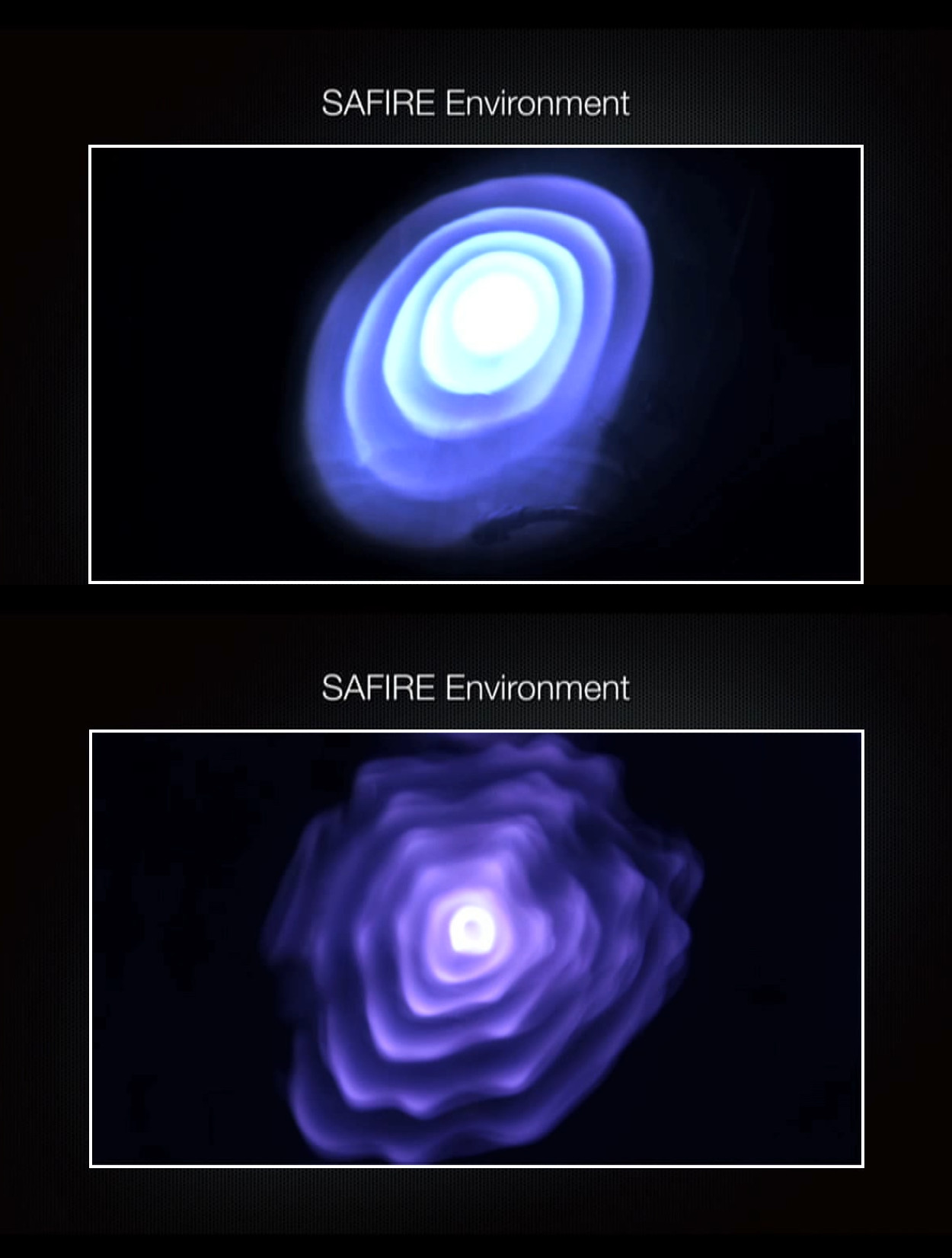
Early images from the SAFIRE Project (Phase I). [Image: Composite of video screenshots.]

More refined observations and control of the plasma double layers came slightly later, as in this still frame from a presentation in 2017 (video of the evolving double layer shells in the experiment is slightly later, at this timestamp):

Later, more refined & controlled nested spherical "double layer" shells
inside the SAFIRE Project test chamber. [Image: video screenshot]

The JWST observation, however, was not reported until late 2022 (fully 7+ years after the SAFIRE Project had initially observed presented its experimental observations in 2015 [or earlier]).

So, for me, unlike for the JWST team, there was little if any "shock" or "surprise" at their observation of such a multi-shelled structure around one or more stars. 

In fact, to my mind, to the contrary, it should be an *expected* observation around stars, *under specific electrical/plasma conditions*, commensurate with the prior experimental observation in the SAFIRE Project test chamber, *if the Electric Sun/Star hypothesis is true and/or the experimental results obtained in the SAFIRE Project test chamber are applicable/scalable to stellar and/or cosmological scales.* [And we already know that plasma behaviors, and structures are scalable, spatially and temporally, over many O.O.M. (orders of magnitude).]

And, just as in the JWST observation (from Ryan Lau, previously quoted):

"I was amazed. Although they resemble rings in the image, the true 3D geometry of those semi-circular features is better described as a shell."

SAFIRE Project lead Monty Childs described the evolution of the Double Layer shells thusly, in his earlier 2016 presentation:

"...And these, uh, these 'double layers' ... We ended up finding that we had two, three, four, ... twenty. {!} These aren't, uh, disks, these are spherical, um, discharges. Plasma has a unique characteristic where it's translucent as you look through the center of it, and it looks like it's a disk. But, in fact, it's not. What you're looking at, actually, are spheres."

Not only are the 'double layers' spherical in the SAFIRE Project test chamber, but you can get more than one shell... 2, 3, 4, ... 20! Again, just as in the JWST observation of [at least] 17 currently observable concentric shells around WR 140... 

Electrical effects in plasma can *directly* and *reproducibly* generate *precisely* the multi-shelled structure observed by JWST [7+ years after the SAFIRE Project results].

In my opinion, this should probably be headline news. 

There should at least be a reasonable, reasoned discussion of the SAFIRE results / observations and their potential applicability to stellar atmospheres [precisely the domain it was designed to investigate], and to the cosmos at large. Presumably the SAFIRE Project team could give some insight into what they observed in the test chamber, under what specific discharge regimes, and thus what specific characteristics to look for in astrophysical observations of WR 140 in order to further investigate, differentiate between the models, and decide which theory/explanation most accurately fits/explains empirical observation.

Further, should the result/correlation be upheld, it nigh demands a careful reconsideration of some basic tenets of modern stellar theory and likely cosmology at-large, since this experiment stems not from the 'Standard Model,' but instead from the 'Electric Universe' / 'Electric Star' Model(s), wherein the prime mover and shaker of the cosmos is not the exceedingly weak force of gravitation, but the 39 OOM stronger [that's 10^39 or a 1 with 39 zeroes after it {!} times stronger] electromagnetic force...

In that model, the 'galactic web' is not 'neutral' or 'dead' but a network of interconnected 'power lines' [of a sort] lighting up, well, basically EVERYthing (stars, galaxies, etc.). Far more can be said on that, but I'll confined my remarks to the subject at hand for now, as a microcosm of the macrocosmic issue(s) at hand.

Given recent apparent falsifications of the Big Bang (fully formed galaxies with too high a redshift, thus allegedly "too mature, too early after the [alleged] Big Bang") and other tenets of the 'Standard Model,' it's about time to shake things up, and shift our thinking to a new paradigm. 

In my considered opinion, that is some flavor of Electric Universe, Plasma Cosmology, Magnetohydrodynamic Universe, Electrodynamic Universe, or however you bloody well want to phrase it. 

It's all the same song and dance. And it's time to do the Electric Slide/Boogie, 'cause ... according to They Might be Giants: "The Sun is a Miasma of Incandescent Plasma..." [Well, you're almost there, anyway! Just a few steps more...] Sing us out, boys!


Monday, March 26, 2012

Lasers Shine Light on the Electric Universe

All roads lead to one inevitable conclusion: As electric currents produce magnetic fields, any magnetic fields we observe must be produced by electric currents. New research using lasers shows that even where shock waves and magnetic fields correlate, it is an electric current loop that generates the magnetic field.

Science marches blindly onward. The time has come to remove the blinders and explore our Electric Universe.

Galactic magnetic fields have been a thorn in the side of gravitational cosmology for the better part of a century. Where do they come from? How did they get there? Why do they persist? Why didn't gravitational cosmology predict them? Why are Hannes Alfvén's predictions almost always prescient? (Okay. Ambiplasma may have been a garden path. We can accept that. Nobody's perfect.)

Simply put, those who espouse gravitational models of the universe seems to willingly put on blinders to the efficacy of the electromagnetic field in explaining the workings of the universe. Hopefully this blog serves to peel back the veil ever so slightly.

The current leading contender for 'how galactic magnetic fields got there' in the gravitational universe are so-called magnetic 'seed fields,' unexplained small-scale fields that somehow get whipped up and amplified into bigger fields through 'dynamo action.'
"Scientists believe that galactic magnetic fields are generated from weaker seed fields. These seeds are then amplified via a dynamo mechanism, in which the rotation and turbulence of the galaxy’s interstellar medium – the gas and dust between stars – acts to reinforce the original magnetic field."
http://www.cosmosmagazine.com/news/5222/lasers-shine-light-galactic-magnetic-fields

But, how did the 'seed fields' get there? Magic? God put them there when He created everything from nothing? Man put them there when he mathematically created everything from nothing (the Big Bang)?
"However, this mechanism doesn’t explain how the seed fields themselves come into being."
http://www.cosmosmagazine.com/news/5222/lasers-shine-light-galactic-magnetic-fields

Since electric currents are not generally permissible in a gravitational universe (they either don't exist at all, don't exist on the largest scales or don't do anything of consequence, depending who you ask), some other method of creating magnetic fields must come into play. Seemingly, the only other way of generating high-energy events is collisions (banging things together).
"One of the proposed methods for creating seeds is via shock waves..."
 http://www.cosmosmagazine.com/news/5222/lasers-shine-light-galactic-magnetic-fields
So, when all else fails, it seems 'shock waves' are invoked to get things going. Though, why 'shock waves' should be expected to generate magnetic fields isn't entirely clear, other than the fact that something has to do it.

I wonder, does a bullet flying through air produce a magnetic field? It certainly generates a shock wave. I suppose it might be an interesting experiment... Though, it's outside the scope of this blog.

To test the hypothesis, scientists have created a shockwave in the lab using a high-power laser.
"[A] pulsed laser was directed at a small carbon rod inside a chamber filled with helium gas [to mimic an explosion] ... This explosion created a shock wave ahead of the expanding material. As the shock wave moved through the plasma in the chamber, a current loop was created, which in turn generated a magnetic field."
http://www.cosmosmagazine.com/news/5222/lasers-shine-light-galactic-magnetic-fields
As expected, the shockwave generated a magnetic field. Indirectly. The shockwave generated a current loop (an electric current), which in turn generated the magnetic field. This process is known as the 'Biermann battery.' Now, the Biermann battery effect was what they were looking for. So, kudos for that... But the worry is that now science will put its blinders back on and ignore the middle man (electric currents), claiming that 'shock waves generate magnetic fields, enough said.' Too often this kind of pseudo-pedagogical oversimplification is what creeps in.

We should be cautious to always remember the causal chain of events. Yes, a shock wave can lead to a magnetic field, but only through the generation of an intermediary electric current and not through any other action. In the end it is the electric current that produces the observed magnetic field.

So, really what they have confirmed, once again, is that electric currents are the sole source of magnetic fields in the universe (as was pointed out in the initial post of this blog). A shock wave is merely one method of producing an electric current.

It is, thus, still the contention of this blog that where magnetic fields are observed in the universe, we must work backward and ask what electric current systems are driving them.
"Electric current can be directly measured with a galvanometer, but this method involves breaking the electrical circuit, which is sometimes inconvenient. Current can also be measured without breaking the circuit by detecting the magnetic field associated with the current."
http://en.wikipedia.org/wiki/Electric_current#Electromagnetism
Magnetic fields are diagnostic for electric currents. By observing magnetic fields we can infer that a current is present and determine characteristics of that current. This holds just as true in space as it does here on Earth in the lab. For instance, astronomers recently announced the strongest electric current observed thus far in the universe flowing in the jet of galaxy 3C303.

The scientists testing the shockwave hypothesis, however, caution that shock waves are not the only method that has been proposed for generating magnetic 'seed fields.' Other hypotheses includes stars or other objects 'casting off' their magnetic fields into interstellar space. Such a 'casting off' is nonsense, since magnetic fields cannot be 'frozen in' to plasma as has been repeatedly claimed by astronomers (Don Scott).

Unmentioned is the assertion decades ago by Hannes Alfvén that galaxies should be expected to possess magnetic fields owing to the fact that they are electrical structures not dissimilar to a unipolar inductor. If this is so, then so-called 'seed fields' would be an unnecessary artifice, as the electric currents flowing in and around a galaxy analogous to a unipolar inductor would be the only source required to account for the observed magnetic fields.

Perhaps some day soon, we can dispense with the need for 'seed fields' altogether and move to a fully electromagnetic explanation of the ubiquitously observed magnetic fields throughout the universe. So ubiquitous are they, in fact, that a number of mainstream publications have alluded to the fact that we live in a "Magnetic Universe."

But, what is a "Magnetic Universe" if not a second order "Electric Universe" wherein the cart has been placed before the horse?
"Underpinning all this is a serious problem: we simply don't know what created this cosmic magnetism, or how it has maintained its strength over billions of years ... We don't [know] when or how the first magnetic fields were generated, or how they have stayed so strong and ordered over billions of years. "
http://www.cosmosmagazine.com/features/online/4248/the-magnetic-universe
If we can agree that "electric currents are the sole source of magnetic fields in the universe," as was also put forth in the initial post of this blog, then we should also agree that any such "Magnetic Universe" must more fundamentally be an "Electric Universe." Steady magnetic fields arise from steady electric currents. Changing magnetic fields arise from changes to the underlying currents. Thus, if we see that magnetic fields in the universe persist and remain stable, we must also assume that the feeder currents also persist and remain stable.

That currents exist and do things of interest, must at this point become relatively non-controversial. It's time to acknowledge that obvious fact and move forward with our newer and more complete tool set. Where we see magnetic fields, we should seek to determine the underlying current structures.

Perhaps our universe is more readily knowable than we had heretofore dreamed? Galactic unipolar inductors, filamentary nebulae compressed by electromagnetic forces, high energy impulsive events driven by exploding circuits, and so on. All knowable, all testable hypotheses given a more complete understanding.